

Triad News
Triad News
U.S. Department of Education Releases Proposed Rule on OBBBA Pell Grant Provisions
The U.S. Department of Education (ED) has published a proposed rule related to two changes made to the Pell Grant program by the One Big Beautiful Bill Act.
The first change prohibits students from receiving Pell Grants during any period in which they receive non-Federal grant or scholarship aid that equals or exceeds their cost of attendance.
The second change extends Pell Grants to “eligible workforce programs,” referred to as Workforce Pell. Students will be eligible to receive Pell Grants for programs that, among other criteria:
- Are 8–14 weeks and 150–599 clock hours in length;
- Are approved by the state’s governor, in consultation with the state workforce development board, and the U.S. Secretary of Education;
- Align with the requirements of “high-skill, high-wage, or in-demand industry sections or occupations,” as determined by the governor;
- Lead to a “recognized postsecondary credential that is stackable and portable” or prepare students for employment “for which there is only one recognized postsecondary credential,” and provide academic credit toward a subsequent degree at one or more institutions in a written agreement; and
- Meet annual outcome metrics, including a 70% completion and 70% job-placement test.
The Administration aims to have the Workforce Pell Grant program operational by July 1, 2026.
Comments on the proposed rule will be accepted until April 8, 2026. Included in the proposed rule are Directed Questions seeking feedback on specific proposals.
U.S. Department of Labor Announces Funding for Community Colleges Implementing Workforce Pell
The U.S. Department of Labor (DOL) has announced that it will grant $65 million in funding to community colleges working to develop high-quality, short-term, in-demand training programs that align with the new Workforce Pell program.
This funding, part of the Strengthening Community College Training Grants, will allow individual projects to receive up to $11 million.
Applications are due by May 20, 2026.
ED Creates Additional Interagency Agreements
ED has announced two new interagency agreements (IAAs) between ED and other federal agencies.
- ED and the U.S. Department of State (State) are establishing an IAA related to foreign gift and contract reporting for certain institutions of higher education, as required by Section 117 of the Higher Education Act of 1965.
- ED and the U.S. Department of Health and Human Services (HHS) are establishing an IAA that will shift more responsibility for the administration of school safety programs to HHS.
This move follows ED’s announcement of six new IAAs impacting the management of higher education-related programs in November 2025 and the creation of the Workforce Development Partnership in July 2025.
ED Releases Interpretive Rule on Recognizing New Accreditors
ED has published an interpretive rule that would significantly decrease the timeline for new accreditors to be recognized by ED.
Previously, ED regulations required accreditors to have conducted accrediting activities for two years prior to seeking recognition from the Department. ED’s review of applications for recognition then took a further 2–3 years to complete.
ED has reinterpreted this regulation in light of President Trump’s Executive Order 14279, which instructed ED to, among other actions, “[r]esume recognizing new accreditors to increase competition” and “[i]ncrease the consistency, efficiency, and effectiveness of the accreditor recognition review process.”
The interpretive rule states that new accreditors may seek recognition so long as they have formed a corporation and “conducted at least one type of accrediting activity” from the following list:
- Adopted accreditation standards;
- Granted or denied accreditation or preaccreditation;
- Conducted a site visit at an institution or program;
- Adopted operating procedures; or
- Established a process to accept applications for accreditation.
Accreditors still must have granted preaccreditation or accreditation to at least one institution prior to recognition.
ED further announced its intention to shorten the timeline of its own review to at most 60 days for the initial staff analysis of basic eligibility requirements and 12 months for its complete review of the written petition. As this is an interpretive rule, there is no comment period or feedback mechanism.
ED Issues Proposed Rule Discouraging Use of “Regional” Terminology in Accreditation
ED has published a proposed interpretive rule regarding the continued use of the term “regional” in relation to institutional accreditation by accreditors, institutions, and states.
In 2020, ED implemented a rule that ended the Department’s recognition of accrediting agencies as “regional” and its differentiation between “regional” and “national” institutional accreditors. However, the related 2019 proposed rule stated that “agencies would not be prohibited from identifying themselves as they deem appropriate.”
The new proposed interpretive rule would formally rescind the 2019 language on accreditor self-identification, clarify that the “use of ‘national’ or ‘institutional’… are the sole descriptors allowed” under the Higher Education Act, and “strongly discourage” accreditors from referring to themselves as “regional.”
The proposed rule further “strongly encourages States, including State licensure boards, to revise their laws or regulations, as necessary, to remove this distinction” and encourages institutions to “consider only referring to their accreditation status as being with a ‘nationally recognized accrediting agency.’”
Comments will be accepted until March 19, 2026.
Highlighted Trend in State Higher Ed Policy: Program Enrollment and Earnings Tests
Several states are considering or have recently passed legislation aimed at eliminating programs from public institutions that do not meet certain thresholds for student enrollment and/or student outcome measures.
In 2025, states including Indiana, Utah, Ohio, and Texas passed legislation requiring or incentivizing public institutions to eliminate programs with low enrollment or conferral rates.
Currently, legislators in states such as Indiana and Missouri have passed or are considering bills that would require public institutions to eliminate programs that fail the federal earnings test enacted by the One Big Beautiful Bill Act.
The Governor of Oklahoma also recently issued an executive order that, among other items, requires the Oklahoma State Regents for Higher Education to consider wage and employment outcomes when approving, reviewing, and evaluating programs.
Advocacy Agenda
HLC maintains an Advocacy Agenda that outlines its advocacy priorities related to federal and state regulations and legislation that apply to accreditation and higher education.
HLC’s Relationship Within the Triad
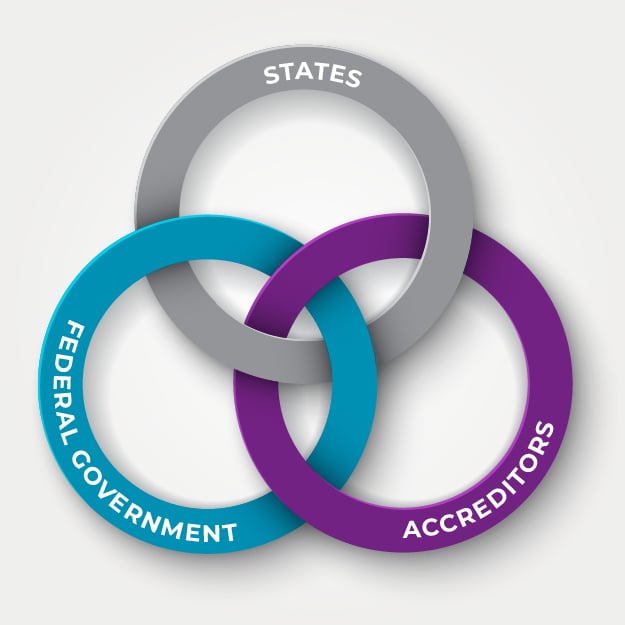
HLC has developed a statement on its Relationship Within the Triad to explain the shared oversight and the interconnected higher education environment in the United States. In particular, HLC notes in its statement that:
“The college or university’s mission is central to HLC’s accreditation and assurance of academic quality. In determining whether institutions meet HLC requirements, HLC considers the institution’s mission. An accredited institution demonstrates how it meets HLC requirements through a mission-reflective lens.
Should any of HLC’s requirements overlap with requirements from other members of the Triad, we work with the other Triad members to identify these situations and limit the burden on the institution.
HLC does not prescribe how a member institution meets HLC’s requirements. If a requirement of another entity of the Triad may appear to limit an institution’s ability to meet HLC’s requirements in a particular manner, an institution has the flexibility within HLC’s requirements to identify other ways to demonstrate it meets HLC’s requirements.”
Questions?
Contact [email protected].


Stay Connected
Subscribe to our email interest list to get news updates from HLC.