

Triad News
Triad News
AIM Negotiated Rulemaking Committee Second Week of Negotiations Underway
On April 17, the U.S Department of Education (ED) Accreditation, Innovation, and Modernization (AIM) negotiated rulemaking committee completed the first of two weeklong sessions related to ED’s criteria and regulations for accrediting agencies. The negotiated rulemaking committee’s second session is currently underway.
All materials related to the AIM Committee, including proposals already put forward by negotiators and the regulations as proposed by ED going into the second week of negotiations, can be found on ED’s website.
HLC closely followed the committee’s first session and maintained frequent communications with negotiators throughout. A number of the proposed regulatory changes would significantly increase the specificity or prescriptiveness of accreditors’ standards, thereby increasing institutional burden. HLC will continue to offer input wherever possible throughout this process.
ED Publishes Final Rule on Workforce Pell
On May 19, ED published the final rule on Workforce Pell. This was the first rule to come out of the AHEAD negotiated rulemaking committee.
How to Demonstrate an Undergraduate Certificate Program Is Included in an Institution’s Scope of Accreditation
ED indicates that an “institution must be able to demonstrate that each [educational] program (including eligible workforce programs—collectively or individually) is formally accredited and included within its grant of accreditation.”
An institution that needs to demonstrate that an undergraduate certificate program that it may intend to be an eligible workforce program is included within its scope of accreditation should follow HLC’s notification and approval process for educational programs.
An institution should start this process by completing the certificate program screening form to notify HLC of a certificate program and determine if an application is required.
Additional Guidelines Coming Soon
HLC is developing additional guidelines for institutions regarding how to demonstrate compliance with HLC requirements, including the Criteria for Accreditation, in the context of certificate programs, particularly certificate programs that are intended to be eligible workforce programs.
Questions? Contact your institution’s HLC staff liaison.
President Releases Fiscal Year 2027 Budget Request
The Trump Administration has released the President’s Budget for Fiscal Year (FY) 2027. The budget requests $76.5 billion in discretionary budget authority for ED for FY2027, a $2.3 billion decrease from the 2026 enacted level.
Among other items impacting higher education, the budget would eliminate funding for the TRIO and Gear Up programs as well as for Federal Supplemental Educational Opportunity Grants. It would also make significant cuts to Federal Work-Study funding, the Office for Civil Rights, and the Institute of Education Sciences.
The budget maintains the maximum Pell Grant award at its current level and increases program funding by $10.5 billion to help address a looming shortfall in the program.
Education Secretary Linda McMahon has testified before a Senate Appropriations Subcommittee regarding ED’s budget proposal.
ED Publishes Proposed Rule on Earnings Accountability
ED has published its proposed rule related to the Student Tuition and Transparency System (STATS) and earnings accountability measures negotiated through the AHEAD negotiated rulemaking committee. The proposed rule interprets provisions from the One Big Beautiful Bill Act (OBBBA), enacted in July 2025, that affect federal student aid policy.
Most notably, the proposed rule would implement a new “earnings premium measure” that would determine access to the Federal Direct Loan Program. It would also expand disclosure requirements related to Pell Grant lifetime limits and to the Student Tuition and Transparency System (formerly called the Financial Value Transparency system).
Comments on the proposed rule are due May 20, 2026.
ED Publishes Final Rule on OBBBA Student Loan Program Changes
ED has published its final rule related to the changes made to the Federal student loan program in the OBBBA. This follows the RISE negotiated rulemaking committee reaching consensus on the language last fall and ED releasing the proposed rule in January 2026.
The OBBBA required the phasing out of the Grad PLUS program and the introduction of new loan limits for graduate students, professional students, and parents. It also phased out the existing Income-Contingent Repayment plans and created instead a new Tiered Standard repayment plan and income-driven repayment plan.
The final rule remains similar to the consensus language developed by the RISE committee. Most provisions of the final rule will take effect July 1, 2026.
ED and U.S. Department of Health and Human Services Announce Child Care Access Means Parents in School Program Grant Competition
ED and the U.S. Department of Health and Human Services (HHS) have announced the Fiscal Year 2026 competition for the Child Care Access Means Parents in School (CCAMPIS) Program. This competition makes available more than $73 million in funding for institutions of higher education to dedicate to campus-based childcare services for low-income students who are parents. CCAMPIS is the first grant competition operationalized under a new ED-HHS partnership announced late last year.
Applications are due May 29, 2026.
Advocacy Agenda
HLC maintains an Advocacy Agenda that outlines its advocacy priorities related to federal and state regulations and legislation that apply to accreditation and higher education.
HLC’s Relationship Within the Triad
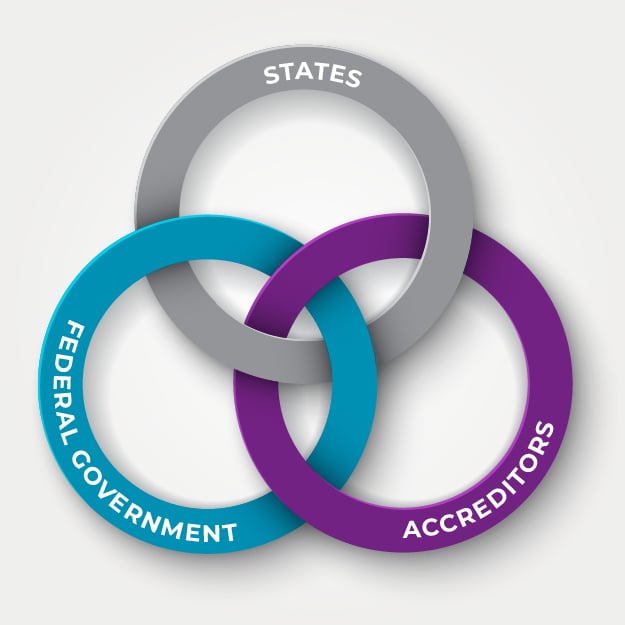
HLC has developed a statement on its Relationship Within the Triad to explain the shared oversight and the interconnected higher education environment in the United States. In particular, HLC notes in its statement that:
“The college or university’s mission is central to HLC’s accreditation and assurance of academic quality. In determining whether institutions meet HLC requirements, HLC considers the institution’s mission. An accredited institution demonstrates how it meets HLC requirements through a mission-reflective lens.
Should any of HLC’s requirements overlap with requirements from other members of the Triad, we work with the other Triad members to identify these situations and limit the burden on the institution.
HLC does not prescribe how a member institution meets HLC’s requirements. If a requirement of another entity of the Triad may appear to limit an institution’s ability to meet HLC’s requirements in a particular manner, an institution has the flexibility within HLC’s requirements to identify other ways to demonstrate it meets HLC’s requirements.”
Questions?
Contact [email protected].


Stay Connected
Subscribe to our email interest list to get news updates from HLC.