

Triad News
Triad News
AIM Negotiated Rulemaking Committee Reaches Consensus
On May 21, the U.S. Department of Education (ED) Accreditation, Innovation, and Modernization (AIM) negotiated rulemaking committee completed the second of two weeklong sessions. At the conclusion of the week, the committee voted to reach consensus on the negotiated regulatory language. Next, ED will publish a Notice of Proposed Rulemaking (NPRM) with a proposed rule that will then be open for public comment. Because the negotiated rulemaking committee reached consensus, the agreed-upon language will be the basis for the proposed rule in the NPRM. Per ED’s AIM negotiator, ED intends to publish the proposed rule this summer and for the final rule to take effect next summer.
All materials related to the AIM Committee can be found on ED’s website.
HLC closely followed the committee’s work and maintained frequent communications with negotiators throughout. A number of the proposed regulatory changes would significantly increase the specificity or prescriptiveness of accreditors’ standards, thereby increasing institutional burden. HLC will comment on the proposed regulations when available and encourages institutions and others affected by these regulatory changes to do likewise.
U.S. House Committee on Appropriations Considers Education Appropriations Bill
The U.S. House of Representatives Committee on Appropriations has released the text and held a mark-up of the Fiscal Year (FY) 2027 Labor, Health and Human Services, Education, and Related Agencies (LHHS) appropriations bill.
The bill was passed favorably out of Committee along party lines.
The FY27 LHHS bill provides $70.7 billion in discretionary funding to the Department of Education, 10 percent below the FY26 enacted level.
Among other provisions, when compared to the FY26 enacted level, the FY27 LHHS bill:
- Increases the maximum Pell Grant by $50 and largely addresses the program’s funding shortfall with approximately $15 billion in additional funding.
- Increases TRIO and GEAR UP funding by $6 million each.
- Maintains steady funding for AmeriCorps.
- Cuts the Supplemental Educational Opportunity Grant (SEOG) by nearly 40 percent.
- Cuts Federal Work Study (FWS) by over 25 percent.
The LHHS bill also includes language restricting funding from an institution of higher education that:
- “[P]rovides recognition, funding, classroom space or services to any student organization which, either individually or through its national headquarters, has provided vocal or material support for a designated foreign terrorist organization, or receives funding for activities from a designated foreign terrorist organization or affiliate thereof.”
- “[A]llows an individual whose sex is male to participate in an athletic program or activity that is designated for women or girls.”
- “[D]enies to a religious student organization any right, benefit, or privilege that is otherwise afforded to other student organizations at the institution (including full access to the facilities of the institution and official recognition of the organization by the institution) because of the religious beliefs, practices, speech, leadership standards, or standards of conduct of the religious student organization.”
Office of Management and Budget Proposes Revisions to Federal Financial Assistance Guidance
The Office of Management and Budget (OMB) has released a proposed rule creating a standardized “Uniform Grants Regulation” framework for federal financial assistance, to apply across all agencies.
HLC joined the American Council on Education’s comment letter to the Department expressing concerns related to the framework’s impact on higher education.
Among other provisions, the new framework would:
- Require senior appointees to conduct pre-issuance merit reviews of discretionary awards to ensure that the awards “advance the President’s policy priorities, prohibit the use of funds for discriminatory or otherwise impermissible purposes, and emphasize ensuring compliance with applicable law.”
- Expand “the list of factors that agencies may consider when evaluating applicant risk,” to include an applicant’s history of “questionable practices,” compliance with Section 117, and affiliations with organizations engaged in activities that “violate Federal law, undermine public safety or national security, or advocate for the overthrow of the United States Government.”
- Broaden agencies’ grant-termination authorities and require agencies to “always include the termination provisions… in each Federal award or expressly incorporate them by reference, and… inform recipients of any additional termination provisions that apply to the award.”
- Establish that public entities receiving federal funding “must not discriminate on the basis of the viewpoint, content, or subject matter of speech—including on the basis of political, ideological, or religious affiliation or perspective—in providing services for events, meetings, or other expressive activities.”
- Prohibit, to “the maximum extent permitted by law,” federal awards from being used to “fund, promote, encourage, subsidize, or facilitate”: diversity, equity, and inclusion (DEI) “policies, principles, or practices that violate any applicable Federal anti-discrimination laws”; “[g]ender ideology as defined in Executive Order 14168”; or “[t]he so-called ‘transition’ of a child under 19 years of age from one sex to another.”
OMB intends to publish a final rule by the end of the fiscal year, to take effect October 1, 2026.
ED Announces Four New Interagency Agreements
ED has announced the creation of four new Interagency Agreements (IAAs) with other federal agencies. These follow the ten other IAAs announced over the last year.
- ED and the U.S. Department of Justice (DOJ) have created a “Civil Rights Partnership,” through which the DOJ will become involved in investigating and resolving complaints and enforcing civil rights protections for students. ED will “retain all statutory authorities and functions” related to federal civil rights law.
- ED and DOJ have created a “Student Privacy Protection Partnership,” which aims to “provide guidance to education agencies and institutions regarding their student privacy obligations and investigate violations.”
- ED and DOJ have created a “Training and Advisory Services Partnership” to help public schools “develop and implement plans to desegregate.”
- ED and the U.S. Department of Health and Human Services (HHS) have created a “Special Education and Rehabilitative Services Partnership” with the goal of “support[ing] states and schools as they work to improve outcomes for individuals with disabilities.”
ED Releases STATS Final Rule
ED has published its final rule regarding the new Student Tuition and Transparency System (STATS) and Earnings Accountability rule.
The final rule builds off the language negotiated through the AHEAD negotiated rulemaking committee and interprets provisions from the One Big Beautiful Bill Act (OBBBA) that affect federal student aid policy.
Most notably, the proposed rule would implement a new “earnings premium measure” to determine access to the Federal Direct Loan Program. It would also expand disclosure requirements related to Pell Grant lifetime limits and to the Student Tuition and Transparency System (formerly called the Financial Value Transparency system).
ED has published a fact sheet outlining the rule’s main provisions. Most of the provisions are set to take effect July 1, 2027.
Federal Student Aid Office Updates List of Professional Degree Programs
The Office of Federal Student Aid (FSA) has released an updated list of professional degree programs for the purposes of direct student loan caps following a court order.
The OBBBA, enacted in July 2025, distinguished between graduate and professional degree programs for the purposes of Direct Unsubsidized loan limits, allowing professional degree students to borrow twice as much annually and in aggregate than graduate degree students.
In its RISE final rule, ED limited the definition of a professional degree program to eleven fields of study. A federal court has since temporarily halted the implementation of that professional degree definition. In response to the court order, ED issued guidance including both an updated list of Classification of Instructional Programs (CIP) codes that are temporarily eligible for higher loan limits and a list of programs that have been temporarily removed from eligibility.
ED Releases Regulatory Agenda
ED has released its 2026 Regulatory Plan and the Unified Agenda of Federal Regulatory and Deregulatory Actions.
Per the new regulatory agenda, ED intends to propose or finalize nineteen rules this year, including rules related to Section 117 of the Higher Education Act, the Saving on a Valuable Education (SAVE) Plan, and Title VI of the Civil Rights Act.
State Trends in Higher Ed: Workforce Pell Occupations
The One Big Beautiful Bill Act extended Pell Grants to certain “eligible workforce programs,” commonly referred to as Workforce Pell. On May 19, ED published a final rule regarding Workforce Pell.
The legislation and subsequent regulations provide significant decision-making authority to governors as to which educational programs qualify as eligible workforce programs, within certain parameters. Notably, the legislation requires that an eligible workforce program “provides an education aligned with the requirements of high-skill, high-wage… or in-demand industry sectors or occupations,” as determined by the Governor in consultation with the state workforce board.
Workforce Pell took effect on July 1, 2026. At present, approximately twenty states have issued public application guidance and have begun accepting submissions from institutions. In HLC’s historical region, this includes Arkansas, Indiana, Iowa, Michigan, Minnesota, Ohio, and Wisconsin. Many other states have implemented working groups, named lead agencies, or passed legislation authorizing Workforce Pell, but have not yet operationalized.
Among those states who have established which industry sectors and occupations qualify as high-skill, high-wage, or in-demand for purposes of Workforce Pell, there is a wide variety in approaches. For example, on the low end, Pennsylvania named 19 eligible occupations, while on the high end, North Carolina named 364 occupations. Ohio linked program eligibility to the state’s Top Jobs list.
HLC has published additional information about accreditation requirements for HLC member institutions who are interested in applying for federal funds through Workforce Pell.
Advocacy Agenda
HLC maintains an Advocacy Agenda that outlines its advocacy priorities related to federal and state regulations and legislation that apply to accreditation and higher education.
HLC’s Relationship Within the Triad
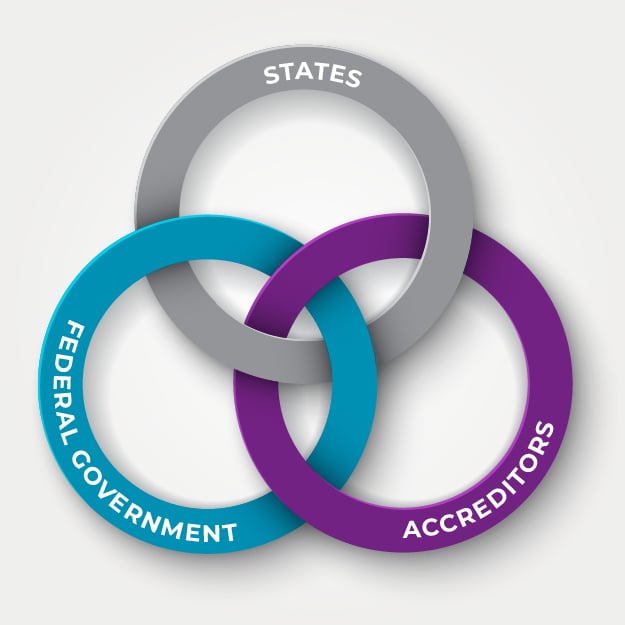
HLC has developed a statement on its Relationship Within the Triad to explain the shared oversight and the interconnected higher education environment in the United States. In particular, HLC notes in its statement that:
“The college or university’s mission is central to HLC’s accreditation and assurance of academic quality. In determining whether institutions meet HLC requirements, HLC considers the institution’s mission. An accredited institution demonstrates how it meets HLC requirements through a mission-reflective lens.
Should any of HLC’s requirements overlap with requirements from other members of the Triad, we work with the other Triad members to identify these situations and limit the burden on the institution.
HLC does not prescribe how a member institution meets HLC’s requirements. If a requirement of another entity of the Triad may appear to limit an institution’s ability to meet HLC’s requirements in a particular manner, an institution has the flexibility within HLC’s requirements to identify other ways to demonstrate it meets HLC’s requirements.”
Questions?
Contact [email protected].


Stay Connected
Subscribe to our email interest list to get news updates from HLC.