

Triad News
Triad News
AIM Negotiated Rulemaking Committee Holds First Meeting
On April 13, the Accreditation, Innovation, and Modernization (AIM) negotiated rulemaking committee will begin the first of two week-long sessions.
The committee has been tasked with developing proposed regulations on a variety of accreditor-related topics, such as simplifying U.S. Department of Education (ED) regulations for recognition and review of accrediting agencies and revising ED’s criteria and regulations for accrediting agencies to emphasize student achievement and outcomes standards.
ED has released draft regulations and a related summary. HLC notified member institutions regarding the draft regulations and will be following the negotiated rulemaking sessions closely and providing input where possible.
HLC Comments on Workforce Pell Proposed Rule
HLC has submitted comments regarding ED’s proposed rule on the new Workforce Pell program. The comments emphasize HLC’s experience providing quality assurance for shorter-term educational programs, including through the Credential Lab, and the applicability of its substantive change policies and procedures to eligible workforce programs. HLC also suggests that ED create a FAQ webpage to help institutions and accreditors when implementing Workforce Pell and providing examples of questions to address.
HLC also joined the comment letter from the Council of Recognized Accrediting Commissions (C-RAC). This letter additionally recommends that Workforce Pell programs be held to the same standards as traditional Pell-eligible educational programs regarding the proportion of a program that may be provided by an ineligible institution or organization via a written arrangement.
C-RAC Comments on U.S. Department of Education Rule Regarding “Regional” Terminology
In February, the U.S. Department of Education (ED) published a proposed interpretive rule discouraging the use of the term “regional” by accreditors, institutions, and states in relation to institutional accreditation.
In response, C-RAC submitted comments to ED supporting the proposed rule. C-RAC membership consists of seven institutional accreditors, including HLC.
The comments confirmed that C-RAC members adjusted their language to remove the term “regional” following the related 2019 rule and encouraged ED to ensure that its materials and communications likewise consistently use the correct terminology. C-RAC also agreed that state laws should be updated to remove references to regional accreditation and specific agencies, and it articulated its commitment to reminding member institutions that there are no longer regional accreditors.
ED and U.S. Department of the Treasury Announce Federal Student Assistance Partnership
ED and the U.S. Department of the Treasury (Treasury) have announced a partnership for administering Federal student aid programs.
Under the new partnership, Treasury will assume operational responsibility for collecting on defaulted Federal student loan debt. Treasury will also, in a phased approach, begin to provide operational support regarding “ED’s efforts to return borrowers to repayment,” non-defaulted Federal student loan debt, and other FSA functions.
ED and U.S. Department of Labor Announce Two TRIO Grant Competitions
ED and the U.S. Department of Labor (DOL) have announced the 2026 grant competitions for the Talent Search Program and the Educational Opportunity Centers Program. The programs have available $175 million and $52 million in funding, respectively.
Both programs award grants to institutions of higher education and nonprofit organizations working to boost student enrollment in higher education. The Talent Search Program focuses on helping students from disadvantaged backgrounds complete secondary school and pursue postsecondary education or training, while the Educational Opportunity Centers Program counsels adults on college admissions and financial literacy. Both programs are administered by DOL on behalf of ED, per a recent interagency agreement.
The Talent Search Program and the Educational Opportunity Centers Program are two of eight Federal TRIO programs. Per ED, competitions for the other programs will be announced later this spring and summer.
Applications for the Talent Search Programs are due May 1, 2026, and applications for the Educational Opportunity Centers Program are due May 14, 2026. ED is hosting ten pre-application webinars for each grant opportunity for interested potential applicants.
President Trump Issues Executive Order Targeting DEI Use by Contractors
On March 26, 2026, President Trump signed an executive order titled “Addressing DEI Discrimination By Federal Contractors.” The executive order directs federal agencies and departments to include in their contracts a clause requiring contractors to attest that they will not “engage in any racially discriminatory DEI activities,” as defined in the executive order.
The executive order defines “racially discriminatory DEI activities” to mean “disparate treatment based on race or ethnicity in the recruitment, employment (e.g., hiring, promotions), contracting (e.g., vendor agreements), program participation, or allocation or deployment of an entity’s resources.”
The executive order also requires contractors to agree to “furnish all information and reports, including providing access to books, records, and accounts, as required by the contracting agency… for purposes of ascertaining compliance” and to “report any subcontractor’s known or reasonably knowable conduct [violating these requirements] to the contracting department or agency.”
Noncompliant contractors or subcontractors may be declared ineligible for further government contracts.
Highlighted Trend in State Higher Ed Policy: Reduced Credit Bachelor’s Degree Programs
Numerous states have taken steps to allow or encourage the creation of reduced credit bachelor’s degree programs. For example:
In 2024, Indiana passed a law requiring public universities to consider the feasibility of offering bachelor’s degrees in a three-year format and to offer one such program by 2025. Ohio followed suit in 2025, requiring each public university to establish at least one 90-credit-hour bachelor’s degree program aligned to an in-demand career area by 2027. In Oklahoma, the House of Representatives recently passed a bill directing the State Regents for Higher Education to examine whether bachelor’s degree programs could be completed in 90 credit hours, following an executive order on the subject signed in February. Iowa, too, considered similar legislation this session.
Meanwhile, in early 2026, the North Dakota State Board of Higher Education approved a pilot program for public institutions to offer reduced credit bachelor’s degrees, and the Minnesota Office of Higher Education revised state standards to allow for reduced credit bachelor’s degree programs. Boards in other states, including Kansas, are working to develop their own policies.
To date, HLC-accredited institutions in a dozen states have been approved by HLC to offer reduced credit bachelor’s degree programs.
Advocacy Agenda
HLC maintains an Advocacy Agenda that outlines its advocacy priorities related to federal and state regulations and legislation that apply to accreditation and higher education.
HLC’s Relationship Within the Triad
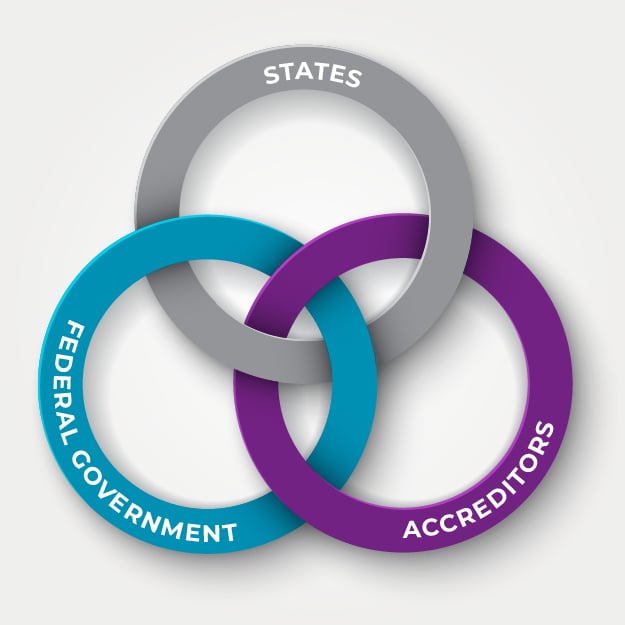
HLC has developed a statement on its Relationship Within the Triad to explain the shared oversight and the interconnected higher education environment in the United States. In particular, HLC notes in its statement that:
“The college or university’s mission is central to HLC’s accreditation and assurance of academic quality. In determining whether institutions meet HLC requirements, HLC considers the institution’s mission. An accredited institution demonstrates how it meets HLC requirements through a mission-reflective lens.
Should any of HLC’s requirements overlap with requirements from other members of the Triad, we work with the other Triad members to identify these situations and limit the burden on the institution.
HLC does not prescribe how a member institution meets HLC’s requirements. If a requirement of another entity of the Triad may appear to limit an institution’s ability to meet HLC’s requirements in a particular manner, an institution has the flexibility within HLC’s requirements to identify other ways to demonstrate it meets HLC’s requirements.”
Questions?
Contact [email protected].


Stay Connected
Subscribe to our email interest list to get news updates from HLC.