

Triad News
Triad News
Reminder: AIM Negotiated Rulemaking
In May, the U.S. Department of Education (ED) Accreditation, Innovation, and Modernization (AIM) negotiated rulemaking committee reached consensus on negotiated regulatory language related to accreditation. On August 20, ED will publish a Notice of Proposed Rulemaking (NPRM) with a proposed rule that will then be open for a 30-day public comment period. The text can be found here. Because the negotiated rulemaking committee reached consensus, the agreed-upon language is the basis for the proposed rule in the NPRM.
All materials related to the AIM Committee can be found on ED’s website.
A number of the proposed regulatory changes would significantly increase the specificity or prescriptiveness of accreditors’ standards, thereby increasing institutional burden. HLC will comment on the proposed regulations when available and encourages institutions and others affected by these regulatory changes to do likewise.
HLC Comments on College Transparency Act
On July 30, the U.S. Senate Committee on Health, Education, Labor, and Pensions (HELP) held a markup of the College Transparency Act (CTA). The bill received nearly unanimous support from the Committee.
HLC joined the Council of Recognized Accrediting Commissions (C-RAC) in sending a letter to Senate HELP Committee leadership supporting the CTA, which would allow for more timely and accurate reporting on critical student outcomes while protecting the privacy of students.
Specifically, the CTA would create a “secure and privacy-protected postsecondary student-level data system” within ED’s National Center for Education Statistics (NCES). Institutions participating in Title IV would be required to provide data to the NCES for this system, while institutions not participating in Title IV may choose to participate.
The NCES would then be required to create a user-friendly website, to include metrics for each institution and post-collegiate student outcomes disaggregated by identity characteristics and program (with protections for data identifying specific individuals).
Each fully participating institution and each state’s higher education agency would receive an annual report from NCES regarding this data, and institutions and states may also query specific non-identifying data.
In its letter to the Committee, C-RAC also urged the Committee to amend the bill to further strengthen the utility and availability of data for recognized accreditors by enabling accreditors to receive data and submit queries on institutional and programmatic outcomes in the same manner as allowed for by institutions and states.
ED Secretary Releases “National Call to Action” Letter for Institutions
Secretary McMahon has published a letter to university leadership calling on all institutions to “describe to the American public [their] commitments to rigorous teaching, pathbreaking research, and national service” and publicly post these “statements of principle” on their websites.
The secretary also included a list of questions for institutions to address, including with regards to admissions criteria, the free exchange of ideas, intellectual pluralism, affordability, academic rigor, foreign influence, and the national interest.
ED hosted a public briefing on the call to action on August 19.
Bills Related to ED Interagency Agreements
The U.S. House Committee on Education and the Workforce has voted favorably on a package of ten bills (referred to as the “Less Bureaucracy, Better Education” package) designed to codify many of ED’s recent interagency agreements (IAAs). ED currently has fourteen IAAs with six other federal agencies.
The bills in this package would, among other provisions, codify the transition of Federal Student Aid (FSA) to the Department of the Treasury; Career and Technical Education, Adult Education, and Office of Postsecondary Education programs to the Department of Labor; and Indian Education programs and tribal college grants to the Department of the Interior. The package does not codify the IAA to move civil rights enforcement to the Department of Justice.
At the same time, the Senate HELP Committee has voted favorably on a bill to prohibit certain IAAs from being implemented.
Specifically, the bill prohibits ED from entering into or implementing any IAAs that would result in ED transferring to another agency any function or program of, or appropriation to: the Office of Special Education and Rehabilitative Services, the Office of Postsecondary Education, the Office of Indian Education, or the Office of Elementary and Secondary Education.
The bills may now be considered by the full House and Senate, respectively.
ED Rescinds Disparate Impact Regulations for Civil Rights Enforcement
ED has published a final rule amending the regulations implementing Title VI of the Civil Rights Act to rescind the portions related to disparate-impact liability.
Per the rule, these amendments will “clarify for recipients of Federal financial assistance from the Department that the Department’s Title VI regulations prohibit intentional discrimination and do not prohibit conduct or activities that have an unintentional disparate impact, and that accordingly, the Department will not pursue Title VI disparate-impact liability against its Federal funding recipients.”
This aligns with an executive order issued by President Trump last year that called for the elimination of “the use of disparate-impact liability in all contexts to the maximum degree possible to avoid violating the Constitution, Federal civil rights laws, and basic American ideals.”
The rule was finalized without a notice and comment period, as ED determined that it was not required based on an exemption to the notice and comment requirement for rules “relating to agency management or personnel or to public property, loans, grants, benefits, or contracts.”
Court Rules in Case on Federal Grant Revocations due to New Federal Priorities
A federal judge has ruled that federal officials cannot cancel existing federal grants solely because they don’t align with new government priorities. The lawsuit was brought by a coalition of 21 attorneys general and three governors.
According to the lawsuit, the administration has terminated billions of dollars in federal grants on the basis that they do not align with governmental priorities. The coalition that brought the lawsuit did not seek to challenge past grant award terminations, instead asking the judge to block future terminations on the basis of new government priorities.
Administration Finalizes Rule Capping International Students’ Stay in U.S.
The U.S. Department of Homeland Security (DHS) has published a final rule capping an international student’s length of stay in the U.S. at four years, regardless of the length of their academic program. Students on F and J visas will be required to apply to DHS for an extension if they need additional time to complete their studies.
In addition, graduate students on F visas (i.e., international student visas) will be prohibited from “changing educational objectives” or transferring institutions unless granted a federal exemption due to “extenuating circumstances,” with undergraduates limited to similar restrictions for their first academic year.
The rule is set to take effect September 15, 2026.
ED Approves First Workforce Pell Program
ED has approved the nation’s first Workforce Pell program. Students in the Emergency Medical Technician program at Iowa Central Community College will now be able to use Pell grants to pay for the program.
At present, just over half of states have begun the process of accepting applications and/or providing state approvals to programs hoping to qualify for Workforce Pell.
Three Programmatic Accreditors Voluntarily Withdraw from Federal Recognition
Three programmatic accreditors—the Midwifery Education Accreditation Council, the Council on Education for Public Health and the Council on Chiropractic Education—have decided to voluntarily withdraw from federal recognition.
Illinois Enacts Law on Student Free Speech
Illinois Governor Pritzker has signed into law the Higher Education Student Support and Academic Freedom Act, to take immediate effect.
The bill outlines student protections on multiple fronts, including: an inclusive and safe learning environment, accessibility, free expression and academic access, freedom of association and organization, peaceful protest, academic transparency, fair evaluation, educational records, insulation of academic programs from undue political interference, career preparation, educational quality, due process, institutional accountability, financial transparency, refunds and withdrawals, and transfer practices.
Advocacy Agenda
HLC maintains an Advocacy Agenda that outlines its advocacy priorities related to federal and state regulations and legislation that apply to accreditation and higher education.
HLC’s Relationship Within the Triad
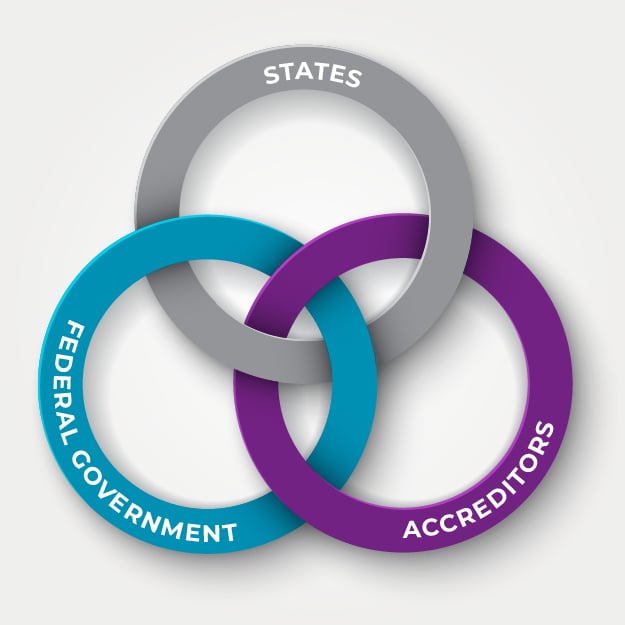
HLC has developed a statement on its Relationship Within the Triad to explain the shared oversight and the interconnected higher education environment in the United States. In particular, HLC notes in its statement that:
“The college or university’s mission is central to HLC’s accreditation and assurance of academic quality. In determining whether institutions meet HLC requirements, HLC considers the institution’s mission. An accredited institution demonstrates how it meets HLC requirements through a mission-reflective lens.
Should any of HLC’s requirements overlap with requirements from other members of the Triad, we work with the other Triad members to identify these situations and limit the burden on the institution.
HLC does not prescribe how a member institution meets HLC’s requirements. If a requirement of another entity of the Triad may appear to limit an institution’s ability to meet HLC’s requirements in a particular manner, an institution has the flexibility within HLC’s requirements to identify other ways to demonstrate it meets HLC’s requirements.”
Questions?
Contact [email protected].


Stay Connected
Subscribe to our email interest list to get news updates from HLC.