
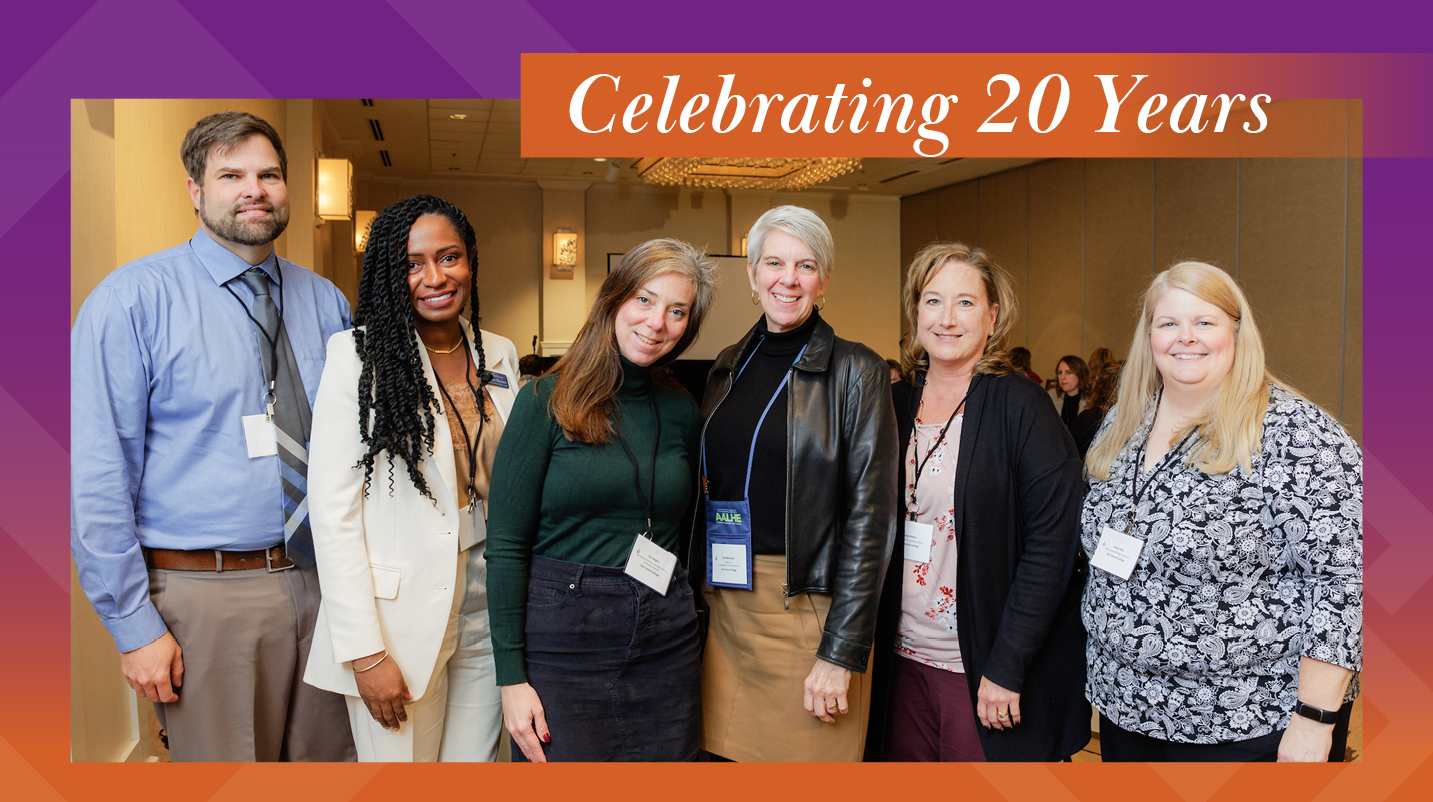
HLC Assessment Academy Marks 20 Years
HLC Assessment Academy Marks 20 Years
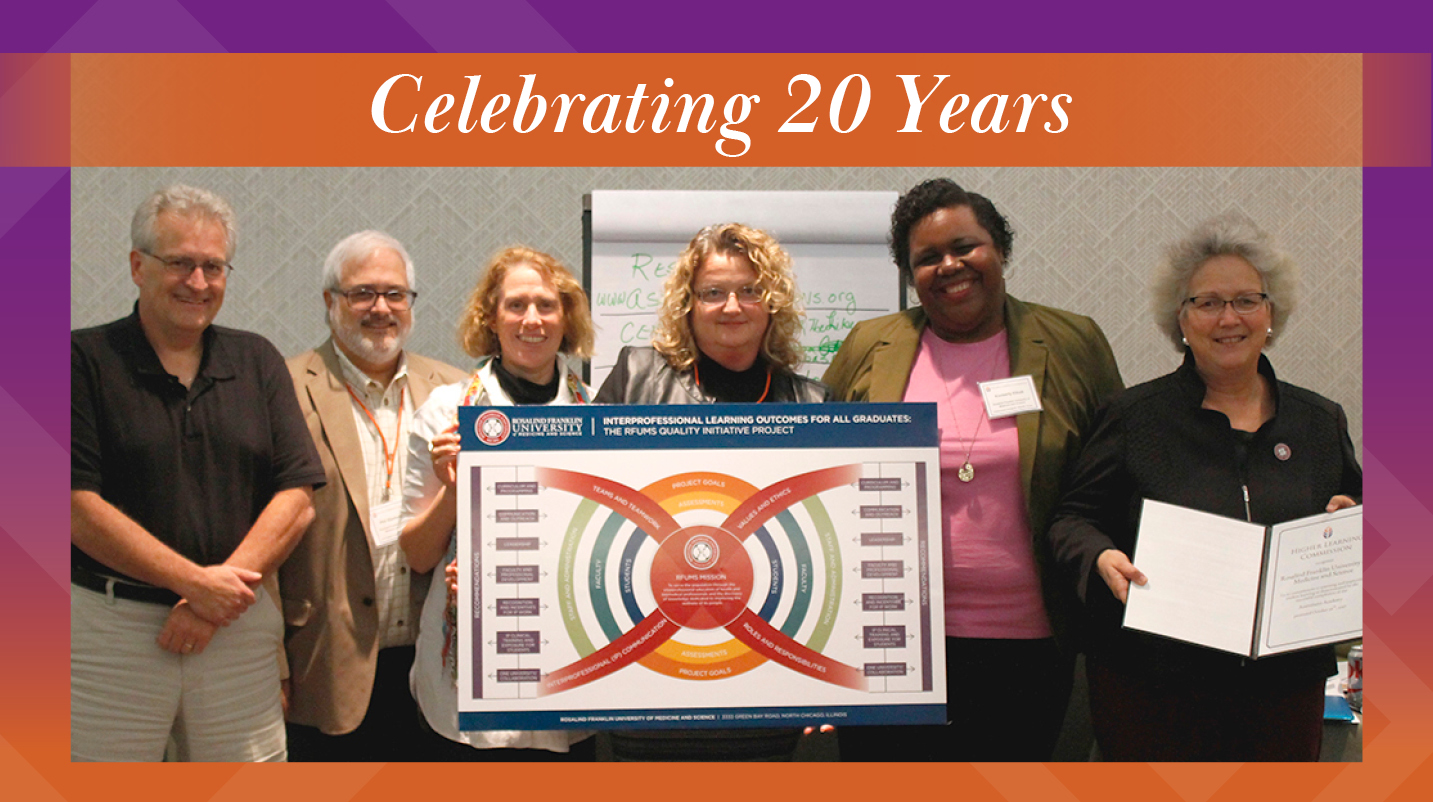
Photo: The 2017 Assessment Academy graduating team from Rosalind Franklin University of Medicine and Science. See more photos below from the Assessment Academy through the years.
The HLC Assessment Academy, a signature program emphasizing improvement of student learning through assessment, is celebrating its 20th year.
The multi-year program was launched in June 2006 to help institutions develop meaningful and effective approaches to assessing student learning. Since then, more than 350 institutions have completed the Academy, implementing projects grounded in their institutional context and priorities and strengthening how they gather, interpret and use evidence of student learning to drive improvement.
“We salute the Assessment Academy on its 20th anniversary,” said HLC President Barbara Gellman-Danley. “This is an amazing program that has encouraged hundreds of higher education leaders across the nation to develop new ways of expanding horizons.”
“We have watched the Academy evolve from a learning source for foundational assessment practices to a recognized leader of guidance for institutions seeking to use data strategically in order to achieve their goals.”
Evolution of Assessment and the Academy
As the Academy prepares to welcome teams from 13 more institutions this fall, its leaders are reflecting on how assessment of student learning and the needs of institutions have changed over the past 20 years.
“In the early days, institutions needed to build the infrastructure to do assessment,” said Susan Hatfield, lead senior scholar for HLC’s Academies and professor emerita at Winona State University in Minnesota.
As more institutions built that necessary infrastructure, the Academy’s focus shifted.
Gail Jensen, vice provost, professor and accreditation liaison officer at Creighton University, has been involved in the Academy for nearly 20 years. She experienced the shifting focus as a participant and then as an Academy mentor, helping to guide other teams through the program.
“In the beginning, it was about putting assessment policies in place, which was a good investment for our institution,” said Jensen. “Today, there are different needs and an entirely different structure.”
“We look for ways to make assessment more practical and meaningful for our institutions,” added Hatfield. “The focus has become student success and ensuring that students can do what they need to do through learning in order to succeed.”
“We stress at the Academy that you have to care about outcomes,” she added. “Otherwise, there’s no point in doing assessment work.”
How to Make Assessment Meaningful and Effective
Drawing on insights from the evolution of the Academy, Hatfield and HLC staff members identified five key takeaways for strengthening assessment and student learning:
- Meaningful assessment starts with meaningful outcomes.
Effective assessment begins with clearly defined learning outcomes that reflect an institution’s mission, context and students. Clear, measurable, action-oriented outcomes are essential. Poorly written outcomes lead to weak data and limit improvement. - Implementation needs to be thoughtful, and leadership is essential.
Assessment development can be slow, uneven and iterative. Sustainable improvement depends on persistence, reflection and adaptation. For real progress, someone needs to be in charge to coordinate efforts, set a realistic scope, and keep the focus on the most meaningful questions about student learning. - The value of assessment lies in the conversations it generates.
Defining outcomes, aligning curriculum, selecting measures, interpreting results, and identifying actions are opportunities for faculty and staff to engage in collaborative conversations about student learning and how to strengthen it. - Improvement must be built into accreditation cycles.
Assessment is incomplete without analysis, sharing results, piloting changes, training stakeholders, and revisiting outcomes to address performance gaps. - Tools support the work but don’t define it.
Software and systems can help, but they cannot replace clarity of purpose, good design or institutional ownership.
From Practice to Purpose: Institutional Experiences
The Academy’s focus on outcomes resonated with Damon Kraft, provost at Kansas Wesleyan University. Kraft is a 2021 graduate of the Assessment Academy and now serves as an Academy mentor.
He was part of a Kansas Wesleyan team at the Academy that crafted specific learning outcomes that students, including many athletes, should be able to meet when graduating.
“Our Academy work has given us a strong sense of who we are at the institution. As a result, we have continued to identify through assessment new opportunities for growth and success,” said Kraft.
“As a mentor, I like to encourage others to always remember that student learning is at the heart of what we’re doing,” he added. “In my mind, the Assessment Academy has been and will continue to be a catalyst for continuous improvement and positive change in higher education.”
Todd DeKay, system government relations officer at Eastern New Mexico State University (ENMU) and an Academy participant while at ENMU-Roswell, also is an Academy mentor.
An Academy participant from 2017–2021, he helped create new assessment processes at ENMU-Roswell and uses the knowledge gained in the Academy to improve ENMU system operations.
“Assessment takes time. You need to have routine processes. It’s greatest value comes from conversations,” he said. “It’s also something that’s vital to the future of higher education —particularly in today’s world — where we are being asked to justify our work and outcomes. I believe the Assessment Academy can help us do that.”
Looking ahead, Jensen sees more changes coming in assessment of student learning, and in turn the Academy. She predicts several new trends on the horizon, including AI and more focus on outcomes.
“We are reimagining what assessment means in these times, which I believe is something the Assessment Academy will continue to do moving forward,” said Jensen.
“We’ll see the Assessment Academy continue to evolve,” she predicted, “but one thing that will remain steady: its focus on improving student learning, which will continue to be central to all in higher education.”


Stay Connected
Subscribe to our email interest list to get news updates from HLC.