

Triad News
Triad News
HLC Comments on ED Accreditation Handbook Request for Information
The Higher Learning Commission (HLC) submitted a comment letter in response to the U.S. Department of Education’s (ED) Request for Information regarding the Accreditation Handbook. The Accreditation Handbook is guidance from ED that clarifies the requirements and processes for an accreditor to be recognized by ED. ED intends to update the Accreditation Handbook with an emphasis on making the recognition process more “transparent, efficient, and not unduly burdensome.”
HLC submitted its own comment letter and joined the Council of Recognized Accrediting Commissions (C-RAC)’s letter.
ED Announces Formation of New Negotiated Rulemaking Committee
ED has announced its intent to establish the Accreditation, Innovation, and Modernization (AIM) negotiating rulemaking committee, which will convene for two weeklong sessions this April and May. Per ED’s notice, the committee will develop proposed regulations on a variety of accreditor-related topics, such as simplifying ED’s regulations for recognition and review of accrediting agencies and revising ED’s criteria and regulations for accrediting agencies to emphasize student achievement and outcomes standards.
Nominations for negotiators are being accepted from a wide range of constituencies including:
- Veterans and U.S. military service members
- Organizations representing taxpayers and the public interest
- Organizations representing workforce development needs, professional associations, or employers
- Legal assistance organizations, consumer advocates, and civil rights organizations that represent students or borrowers
- Recognized institutional accrediting agencies
- Recognized programmatic accrediting agencies
- Nascent accreditation organizations not currently recognized
- Public institutions, including community colleges, Tribal colleges, and Historically Black Colleges and Universities (HBCUs)
- Private nonprofit institutions, including institutions with a religious mission, Tribal colleges, and HBCUs
- Proprietary institutions
- State officials, including state higher education executive officers and state authorizing agencies
The deadline to submit nominations for negotiators is February 26, 2026.
ED Issues Notice of Proposed Rulemaking on Student Loan Changes
ED has issued a Notice of Proposed Rulemaking related to changes to the federal student loan program included in the One Big Beautiful Bill Act.
The Act required the phasing out of the Grad PLUS program and the introduction of loan limits for graduate students, professional students, and parents. This Notice of Proposed Rulemaking follows the consensus reached by the Reimagining and Improving Student Education (RISE) negotiated rulemaking committee, which reached consensus on the full package of proposed regulations in November 2025.
The deadline for comments is March 2, 2026.
ED Awards FIPSE Grants
ED has announced the release of the $169 million in Fund for the Improvement of Postsecondary Education (FIPSE) Special Projects grants, first made available to applicants this past November. ED’s priorities for these grants included Artificial Intelligence (AI), civil discourse, accreditation, and quality short-term education programs.
The AI, civil discourse, and short-term program priorities each received around $50 million in grants, while the accreditation priority was awarded nearly $15 million across 15 projects.
ED Receives Level Federal Funding in Fiscal Year (FY) 2026
ED is set to receive $79 billion in FY 2026 appropriations from Congress, following both the House and Senate passing a five-bill appropriations package. This is approximately the same amount that was previously appropriated to ED. This appropriation includes funding for TRIO, childcare on campus grants, the Supplemental Educational Opportunity Grant program, and minority-serving institution grant programs, all of which the administration proposed or took steps to defund.
The passage of this appropriations package ended a three-day partial government shutdown during which most ED staff were furloughed.
Advocacy Agenda
HLC maintains an Advocacy Agenda that outlines its advocacy priorities related to federal and state regulations and legislation that apply to accreditation and higher education.
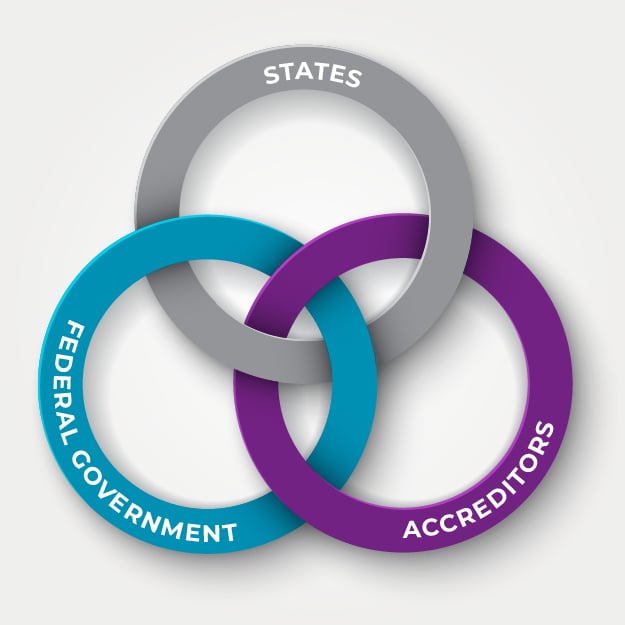
HLC’s Relationship Within the Triad
HLC has developed a statement on its Relationship Within the Triad to explain the shared oversight and the interconnected higher education environment in the United States. In particular, HLC notes in its statement that:
“The college or university’s mission is central to HLC’s accreditation and assurance of academic quality. In determining whether institutions meet HLC requirements, HLC considers the institution’s mission. An accredited institution demonstrates how it meets HLC requirements through a mission-reflective lens.
Should any of HLC’s requirements overlap with requirements from other members of the Triad, we work with the other Triad members to identify these situations and limit the burden on the institution.
HLC does not prescribe how a member institution meets HLC’s requirements. If a requirement of another entity of the Triad may appear to limit an institution’s ability to meet HLC’s requirements in a particular manner, an institution has the flexibility within HLC’s requirements to identify other ways to demonstrate it meets HLC’s requirements.”
Questions?
Contact [email protected].


Stay Connected
Subscribe to our email interest list to get news updates from HLC.