

Triad News
Triad News
U.S. Department of Education (ED) Announces Programs Moving to Other Agencies
ED has announced the creation of six new interagency agreements with four other federal agencies. Per ED, this will allow six programs housed under ED at the time of the announcement to be administered by these other agencies.
The interagency agreements impacting the management of higher education-related programs include:
- ED and U.S. Department of Labor: Postsecondary Education Partnership
- ED and U.S. Department of Interior: Indian Education Partnership
- ED and U.S. Department of Health and Human Services: Foreign Medical Accreditation Partnership
- ED and U.S. Department of Health and Human Services: Child Care Access Means Parents in School Partnership
- ED and U.S. Department of State: International Education and Foreign Language Studies Partnership
This move follows President Trump’s March Executive Order instructing the Secretary of Education to, “to the maximum extent appropriate and permitted by law, take all necessary steps to facilitate the closure of the Department of Education.”
ED Announces Appointments to the National Advisory Committee on Institutional Quality and Integrity (NACIQI)
Secretary Linda McMahon has appointed five new members to NACIQI:
- Robert Eitel, President of the Defense of Freedom Institute
- Joshua Figueira, Deputy General Counsel and Managing Director of the Office of Compliance, Risk, and Legal Affairs at Brigham Young University-Idaho
- Dr. Jay Greene, Senior Research Fellow for the Center of Education Policy at the Heritage Foundation
- Dr. Steven Taylor, policy director and Senior Fellow in Economic Mobility at Stand Together Trust
- Emilee Reynolds, student representative
The Secretary of Education and both chambers of Congress each appoint six members to serve six-year terms on NACIQI.
NACIQI will hold its second meeting of the year on December 16, 2025. The public can register to view the meeting.
ED Requests Comments on Accreditation Handbook Update
ED has issued a request for public comments to inform its efforts to update the Accreditation Handbook, which provides information on ED’s process for recognizing accrediting agencies. The handbook is sub-regulatory, meaning it does not change regulations or the law as written and does not require any further formal process in order for ED to make changes.
ED is particularly interested in comments that address the following questions:
- What policies or standards are encouraging innovation or reducing college costs within the postsecondary education sector and should be retained in or added to the new version of the Handbook? How can the Handbook be designed to be less burdensome?
- Is the Handbook serving its intended purpose? How can it better assist accrediting agencies and associations in evaluating the quality of educational institutions and programs or in applying for Federal recognition?
- How could accreditation standards be updated to incentivize intellectual diversity on campus? What guidance or standards, if any, can the Handbook provide to institutions and programs to help achieve this goal?
- What methods should be incorporated into the Handbook to determine appropriate assessment benchmarks, and what data sources or validation methods could be used to ensure those benchmarks reflect student competency?
The Department invites interested stakeholders to provide comments over the next 45 days on how best to streamline the recognition process and guidance for accreditors. Comments will be accepted until January 26, 2025.
ED Requests Comments on Extensions and Revisions to Information Collection Requests
ED has released multiple notices requesting public comments on proposed extensions of and revisions to information collection requests (ICRs). They include:
- Student Right to Know
- Prison Education Program Accreditation Requirements
- Financial Assistance for Students with Intellectual Disabilities
- Accreditation Participation and Disclosures
Deadlines for comments are listed on each notice.
U.S. House Committee on Education and the Workforce Considers Bill Related to College Scorecard
The U.S. House of Representatives Committee on Education and the Workforce is considering various bills related to higher education, including the Student Financial Clarity Act (H.R.6498), which would update requirements related to the College Scorecard.
Specifically, the bill requires:
- The Secretary of Education to provide comprehensive institutional data on the College Scorecard website, such as each institution’s acceptance rates, cohort default rates, completion rates, cost of attendance, and financial aid statistics. The data must be, to the extent allowed by federal privacy law, disaggregated by several student characteristics.
- The creation of a Universal Net Price Calculator to help students estimate their total costs of attendance, including the ability to compare across institutions and programs.
- Institutions of higher education that received federal funding to develop their own net price calculators.
2025 State Higher Ed Policy Year in Review
In 2025, state legislators collectively considered nearly 2,000 bills and enacted more than 400 laws related to higher education. Of these, more than 165 were enacted by the 19 states within HLC’s historic region.
This is on par with the activity of the past several years, per the annual report from the National Conference of State Legislatures.
The legislation has addressed topics such as college affordability and return on investment; skills-based employment; enrollment and transfer processes; reforming student loan programs; student safety; and the use of DEI programs and practices.
Advocacy Agenda
HLC maintains an Advocacy Agenda that outlines its advocacy priorities related to federal and state regulations and legislation that apply to accreditation and higher education.
HLC’s Relationship Within the Triad
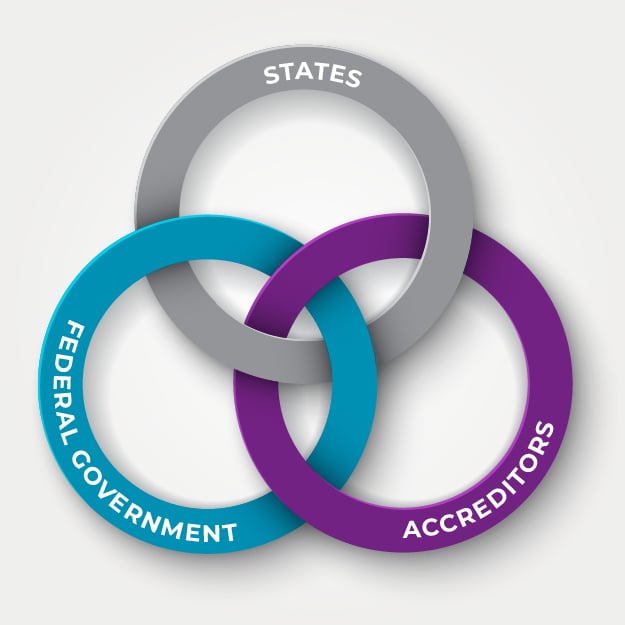
HLC has developed a statement on its Relationship Within the Triad to explain the shared oversight and the interconnected higher education environment in the United States. In particular, HLC notes in its statement that:
“The college or university’s mission is central to HLC’s accreditation and assurance of academic quality. In determining whether institutions meet HLC requirements, HLC considers the institution’s mission. An accredited institution demonstrates how it meets HLC requirements through a mission-reflective lens.
Should any of HLC’s requirements overlap with requirements from other members of the Triad, we work with the other Triad members to identify these situations and limit the burden on the institution.
HLC does not prescribe how a member institution meets HLC’s requirements. If a requirement of another entity of the Triad may appear to limit an institution’s ability to meet HLC’s requirements in a particular manner, an institution has the flexibility within HLC’s requirements to identify other ways to demonstrate it meets HLC’s requirements.”
Questions?
Contact [email protected].


Stay Connected
Subscribe to our email interest list to get news updates from HLC.